
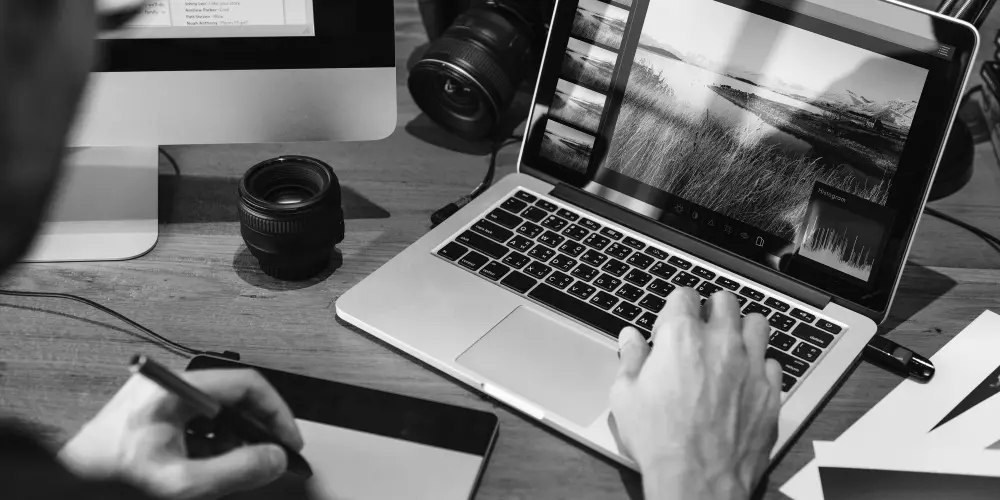
When someone arrives on your website, they form an opinion within seconds. Before reading a word of your text, before looking for your services, before checking your phone number, they look at the images.
This reaction is instinctive. Poor quality photos, generic visuals or blurry screenshots send an immediate signal: either the business lacks resources, or it lacks attention to detail. Either way, that’s not the message you want to send.
What stock photos do to your credibility
Many Luxembourg business websites use free stock photos: hands shaking in front of a white background, people in suits smiling at a screen, generic offices that could be anywhere in the world.
These photos are immediately recognisable. Visitors have seen them hundreds of times on other sites. They convey no information about your business, your premises, your team or how you work. They create an impression of anonymity, the exact opposite of the trust you’re trying to build.
By contrast, an authentic photo of your workshop, your team at work, or a recently completed project says something real about what you do. It anchors your business in a concrete context.
The difference real photos make
Businesses that move from generic visuals to authentic photos typically see a change in how visitors behave on their site.
Time spent on the page increases. People stop on the photos, look at them, scroll to see more. A before/after gallery captures the attention of a visitor who’s looking for exactly that type of work.
Contact becomes more direct. A visitor who has seen your face, your workplace, your work arrives at the contact form with trust already partially established. They’re not contacting a stranger, they’re reaching out to someone they feel they know a little.
The quality of questions changes. Clients who come through a site with detailed photos ask more relevant questions, because they’ve already understood what you do and how you work.
What to photograph first
Not everything necessarily needs a professional photo session. Here’s what has the most impact on a local business website.
People. A photo of you, your team, or simply a person who represents the business radically changes perception. People trust people, not logos. A decent photo, well lit, with a simple background, is enough. No studio required.
Your work. For a craftsman, a service provider, or any business whose output is visible, before/after photos are among the most convincing content you can put on a site. They answer the question “do they actually do good work?” immediately.
Your working environment. A photo of your premises, workshop or workspace gives an impression of reality and solidity. It’s not essential, some businesses have no fixed location, but when it exists, it’s worth showing.
What “professional quality” actually means
Quality doesn’t necessarily mean hiring a professional photographer, though that’s often the most effective solution. What matters is:
Lighting. A dark or overexposed photo is unusable, regardless of the quality of the camera. Natural light, used well, produces good results even with a recent smartphone.
Sharpness. A blurry image creates an impression of carelessness. Taking the time to stabilise the camera and focus makes all the difference.
Relevance. A medium-quality photo that shows something real and relevant to your business is more effective than a beautiful stock photo that says nothing about you.
Optimisation. High-quality photos can significantly slow down a website. A 5MB image converted to WebP can drop to 200–300KB for a visually identical result. This technical work needs to be done when integrating images into the site.
How we handle this at Slash.lu
When building a site, we take the time to look at what you already have, tell you what can be used as-is, what’s worth redoing, and how to optimise your images for the web. If you have nothing, we guide you on what needs to be photographed.
If you’d like us to assess your current site’s visual situation, contact us.
For real-world examples, browse our portfolio.
To understand more about how your website creates a first impression for potential clients, read our article on why businesses lose clients without a website in 2025.
→ Going further: our web design service .
Related articles
Keep reading.
Web Development
Why a Business Without a Website Loses Clients
Today, businesses without a website are invisible to a large share of potential clients. Here's why, and what to do about it.
Read articleWeb Development
7 Common Mistakes on Artisan Websites in Luxembourg
The most frequent mistakes Luxembourg tradespeople make on their websites, and what to do instead to generate real enquiries.
Read articleWeb Development
How to Recover Your Website When the Agency Stops Responding
Your web agency has gone silent? Here's how to take back your domain, hosting, source code and third-party accounts, step by step, without downtime.
Read article