
Your clients still look for you on Google. But they no longer find you only in the list of blue links. There’s the Google Maps panel and, more and more, answers written by AI: the summary Google shows at the top of some searches (the “AI Overviews”), or ChatGPT’s reply when someone asks it for a good electrician in Bertrange.
Do you need to start from scratch? No. This guide takes stock: what doesn’t change, what’s becoming more important, and what to do now to be visible in 2027. No jargon, and no crystal-ball predictions.
Where will my clients look for me in 2027?
In three places that work together:
- Classic Google results: the links to websites. Still there, still essential, especially when the client is comparing and doing research.
- Google Maps and the local map: the businesses shown with the map when someone searches for a trade near them. For a local business, it’s often the first thing the client sees.
- AI answers: Google’s AI Overviews and assistants such as ChatGPT. The client asks a question and gets a written answer, sometimes with business names and links to the sources.
The same client can go through all three in a single day. They ask ChatGPT for advice, check reviews on Google Maps, then visit your website before calling. So your presence needs to be consistent everywhere.
Is classic SEO outdated in 2027?
No, quite the opposite. AI tools don’t pull their answers out of thin air. AI Overviews rely on pages Google already knows, and ChatGPT, when it searches the web, also draws on published, readable websites. A website Google ignores has little chance of being cited by AI.
What has worked for years still works:
- Useful pages that answer real questions. One page per service, saying what you do, for whom, where, and how it works. Not text written for robots.
- A fast website, especially on mobile. A client in a hurry won’t wait, and Google takes that into account.
- Trust: who you are, real projects, photos of your work, a complete legal notice.
- Client reviews on your Google profile, recent, with your replies.
- The same information everywhere: name, address, phone number and opening hours identical on your website, your Google profile, directories and social media.
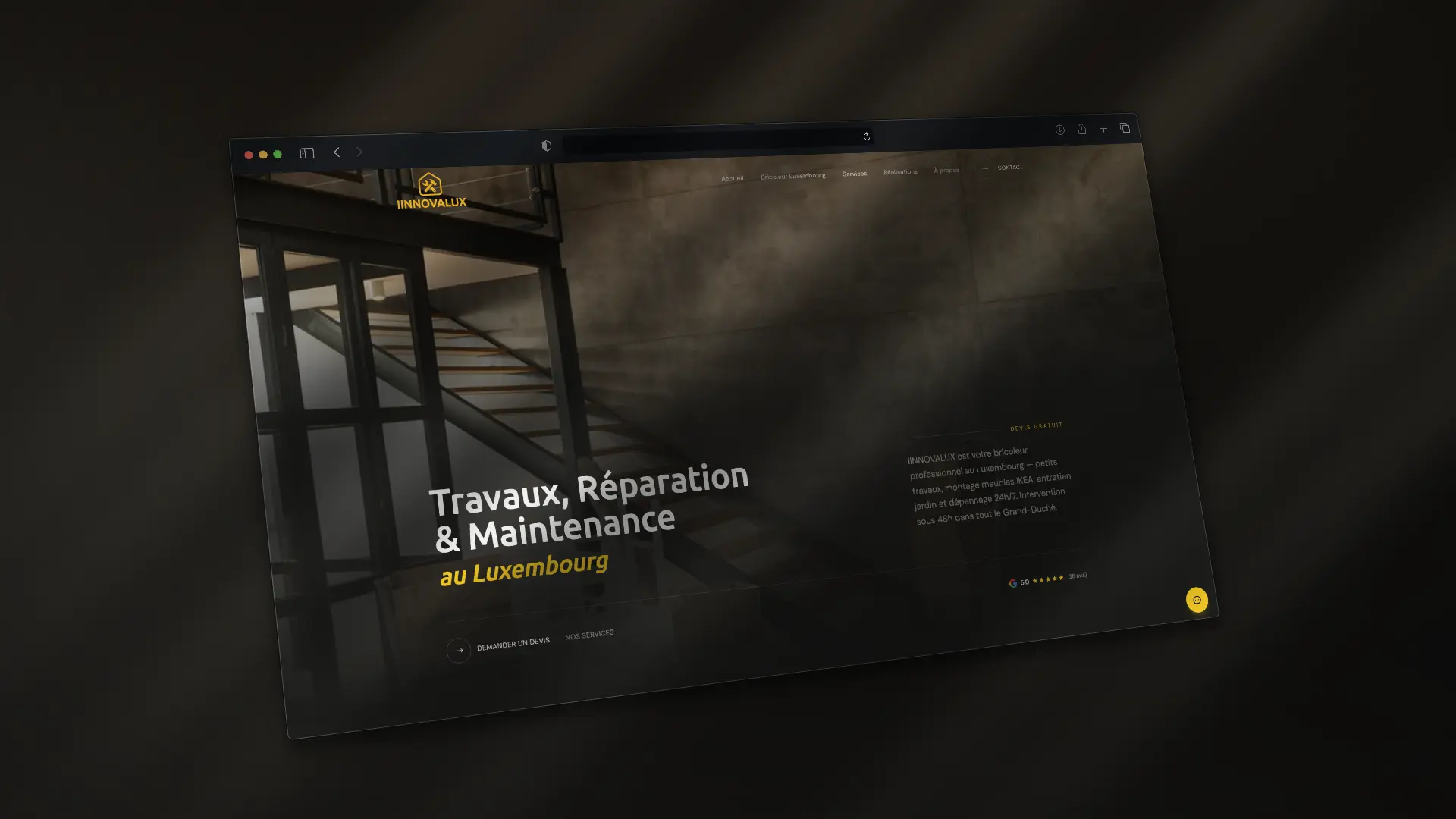
That groundwork is what took tack.lu from one impression a day on Google to more than 100,000 impressions a month. And it’s what got INNOVALUX to first place on Google in four months, with a website scoring 98/100 on Google’s speed test.
How do I appear in AI answers?
Let’s be clear: nobody controls what ChatGPT answers, or what Google shows in its AI Overviews. Be wary of anyone who promises otherwise. But some things improve your chances of being picked up.
- Clear, factual answers. AI looks for sentences that answer a question directly. “We work across the whole canton of Esch, Monday to Saturday” is easier to reuse than a long sales paragraph. Put the answer first, the details after.
- A useful FAQ page, with your clients’ real questions: how a quote works, lead times, service area, guarantees.
- Precise, verifiable facts: service area, certifications, opening hours, languages spoken. A precise piece of information is easier to cite than a vague phrase like “quality service”.
- An ID card for machines: “structured data”, a few lines hidden in your website’s code that describe your business (name, address, activity, opening hours) in a format Google reads directly.
- A website robots can read. If your website blocks robots by mistake, or only shows its content after heavy loading, neither Google nor AI can read it properly.
Why do brand mentions matter more and more?
Links to your website have long mattered to Google. More and more, what also matters is that people talk about you, even without a link: an article in the local press, a mention on a partner’s, supplier’s or trade federation’s website, a professional directory, a forum where someone recommends you.
To an AI, a business mentioned in several places, consistently, is a business that really exists. A business that only exists on its own website is harder to recommend.
In practice: list your business in the serious directories for your trade, ask your partners to mention you, take part in local life (events, associations, sponsorship), and check that your name is written the same way everywhere.
Do I need a website in three languages for SEO in Luxembourg?
In Luxembourg, it’s a real advantage. Your clients search in French, German and English. Both Google and AI assistants generally answer in the language of the question, readily drawing on sources in that language.
A well-written German page can make you visible to cross-border workers and German-speaking clients that your competitors overlook. Three conditions:
- texts written or proofread by someone fluent in the language, not machine translation delivered as is;
- the words people really use in each language: a German-speaking client doesn’t search for “artisan”, they type “Handwerker” or the exact name of the trade;
- the technical settings that tell Google these are the same pages in three languages, so it shows the right version to the right person.
Does my Google Maps profile matter for AI too?
Yes. The information on your Google Business Profile (category, opening hours, reviews, photos) feeds Google’s local results, and it shows up more and more in AI-generated answers when someone looks for a business near them.
So your profile remains a priority:
- the right primary category, the one that precisely describes your trade;
- up-to-date opening hours, including public holidays;
- real photos of your work, added regularly;
- reviews requested after every successful job, and a reply to each one.
The full method is in our guide to ranking at the top of Google Maps in Luxembourg.
What should I do now to be visible in 2027?
Here’s the list, in the order we work through it with our clients:
- Check that Google knows your website. Type “site:yourdomain.lu” into Google. If nothing shows up, start there, with our article website not showing on Google.
- Set up Search Console, Google’s free tool that shows which searches you appear for.
- Complete your Google Business Profile and get into the habit of asking for reviews.
- Align your contact details everywhere: website, Google profile, directories, social media.
- Create one page per key service, with your area and clear answers to your clients’ questions.
- Add an FAQ page, written simply.
- Test your speed on PageSpeed Insights, Google’s free tool, and look above all at the mobile score.
- Plan your languages: at least two, ideally French, German and English.
- Get people talking about you: partners, local press, trade directories.
- Measure every month your calls, quote requests and positions on the searches that matter. Not to make pretty charts, but to know what brings in business.
Where do I start?
SEO in 2027 isn’t a revolution. It’s a higher bar on the basics: being clear, fast, reliable and consistent wherever your clients look. We always start with a review of your presence on Google, on Google Maps and in AI answers, then tell you what’s really holding you back. Discover our SEO service and our Google Maps and Google Ads service. Planning a new website? Read our guide to your website in 2027.
Related articles
Keep reading.
Strategy
Your website in Luxembourg in 2027: what to plan for
Building your website in 2027 in Luxembourg? Google, AI answers, Google Maps, three languages, accessibility, budget and SME Packages aid: the guide.
Read articleSEO
My website doesn't show up on Google: 9 reasons and fixes
Your website doesn't show up on Google? Here are 9 reasons, ranked from most to least common, each with a two-minute check you can run yourself, no tech skills.
Read articleStrategy
AI for small businesses in Luxembourg in 2027: 7 practical uses
AI for your Luxembourg SME in 2027: 7 practical uses, from phone calls to quotes, when to avoid it, how to protect your data and which task to start with.
Read article