
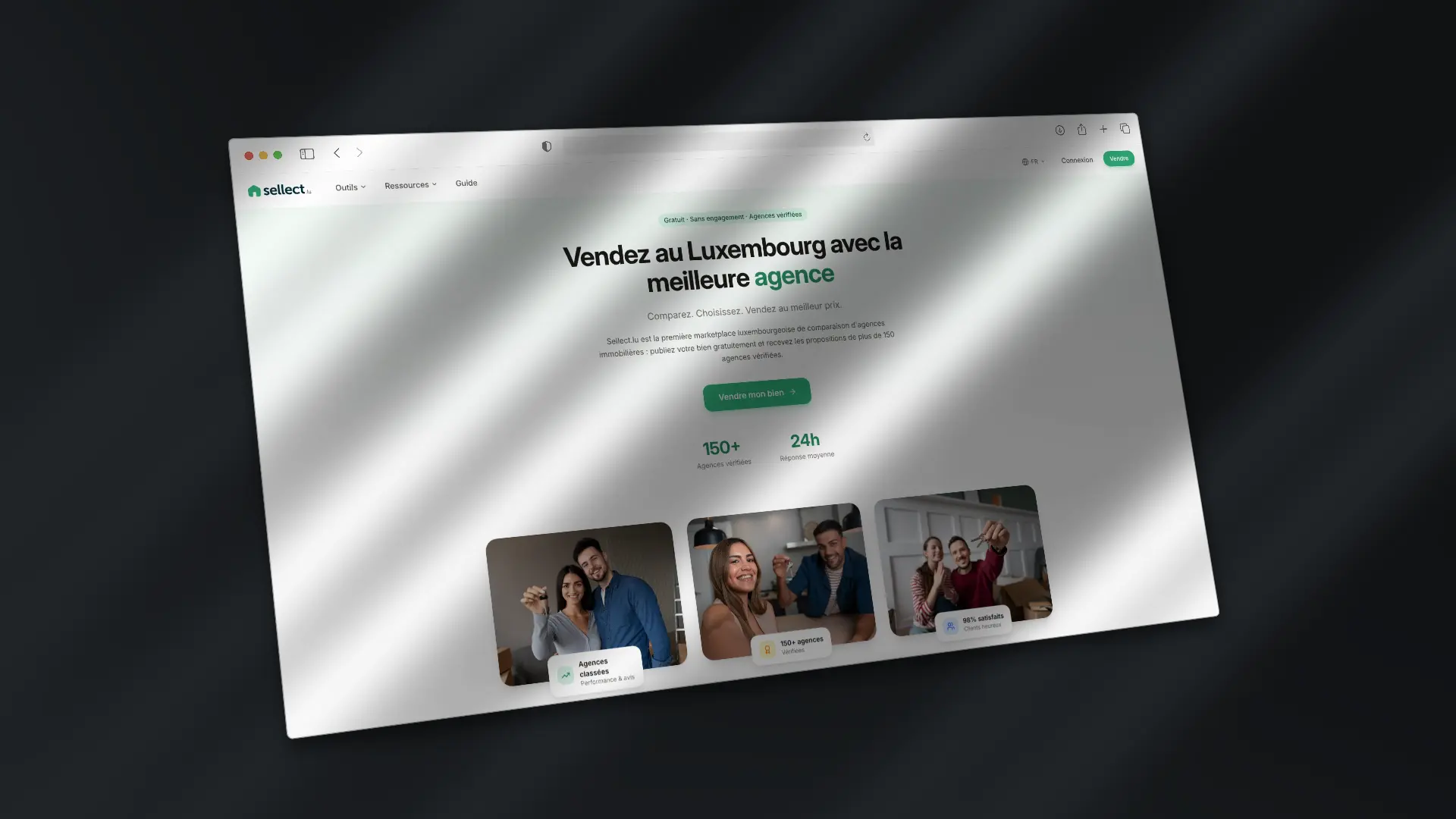
You have a clear idea. A space where your clients follow their file without calling you. A tool that replaces the spreadsheet three colleagues edit at the same time. A platform that connects two audiences, the way Sellect connects property sellers with verified agencies. And one question comes before all the others: how much will it cost?
The honest answer: nobody can give you a serious figure without understanding your project. It isn’t a trade secret. A custom application is built around the way you work, and two projects with the same name (“client portal”, “scheduling tool”) can have almost nothing in common.
What we can do here is show you what drives the budget, how to prepare your request so the quote is reliable, and when it’s better not to go custom at all.
Why can’t anyone give me a price over the phone?
An application is like a house on paper. Its price depends on the floor area, the number of rooms, the plot and the connections to water and power. A price given before anyone has seen the plot is either inflated to cover surprises, or too low and caught up later with “extras”.
At Slash, the quote comes after a free scoping session. It’s a conversation where we describe together what the tool must do, for whom, and what it needs to connect to. You leave with a clear view of your project, even if you decide not to go further with us.
What drives the budget of a custom application?
What the tool needs to do
This is the first factor, by far. Every feature (a calendar, a quote module, a dashboard, notifications) has to be designed, built and tested. The useful question isn’t “what would be nice to have?” but “without what is the tool useless?”.
Who uses it, and with which permissions
A tool only you use is simpler than one shared between your clients, your staff and your partners. As soon as there are several profiles, we talk about “roles”: the client sees their file, the technician sees their jobs, the manager sees everything. You then need to define who sees what, who can change what, and protect every login.
Which tools it needs to talk to
Your accounting software, your calendar, your invoicing tool, an online payment system, your CRM (the file where you track clients and prospects). Every connection to an existing tool is a small project in itself. Some are simple, others depend on what the tool on the other side is willing to share.
Your existing data
Do your client files, ongoing cases or documents need to move into the new tool? Is that information clean and organised, or scattered across several spreadsheets? Bringing existing data across is often underestimated. Yet it’s what lets you use the tool from day one, without retyping everything.
How polished the interface needs to be
An internal tool used by a few trained colleagues doesn’t have the same requirements as a public platform, which must be obvious to someone discovering it alone, on their phone. In Luxembourg, languages often come into it too: French, German, English.
Hosting and ongoing care
An application lives. It must be hosted, backed up, updated and secured. The tools it connects to change, and so do your needs. This ongoing care is part of the real budget. A good quote makes it visible from the start, instead of letting you discover it at the first problem.
Do I have to build everything at once?
No, and that’s often the best decision you can make. We start with a first version that does the essentials, and does them very well. Then we expand it based on real use.
The benefit is twofold. You stay in control of your budget, step by step. And you avoid paying for features nobody will use, because what users really need shows up once the tool is in their hands, rarely before.
How do I prepare my request to get a reliable quote?
You don’t need a specification as thick as a phone book. A few clear points are enough:
- The problem to solve, in one sentence. “We waste hours chasing clients for their documents” beats “we want a portal”.
- The users: who will use it, and roughly how many people.
- Today’s process, step by step, and the one you’d like tomorrow.
- Your current tools: what the application must respect, connect to or replace.
- Must-haves and nice-to-haves: what has to be in the first version, and what can wait.
- Your examples: a tool you like, a screenshot, a sketch on paper. Everything helps.
- Your timeline, and any deadline that cannot move.
With these points, scoping goes quickly and the quote matches the reality of your project.
Wouldn’t an existing tool be enough?
Sometimes, yes. And a good provider should be honest enough to tell you. If your need matches what off-the-shelf software already does (booking, invoicing, e-signatures), a well-configured subscription will often be faster and cheaper.
Custom software makes sense when:
- the way you work is what sets you apart, and standard tools force you to bend it;
- you juggle several programs that don’t talk to each other, retyping data at every step;
- subscriptions pile up for features you only half use;
- you want to give your clients an experience that reflects your brand, not a software vendor’s.
That’s also what scoping is for: checking, with no bias, whether custom is the right answer to your problem.
Who owns the code of my application?
Ask this before you sign, not after. A custom application is an asset of your company. You need to know where the code is (the instructions that make the tool work), who holds the access to the hosting and the domain name, and what happens if you ever change provider.
At Slash, the answer is simple: the delivered code belongs to you, with its documentation. You are never locked in with us. The same reflexes apply to a website, and we cover them in our article on how to verify you really own your website.
Can public funding cover part of the project?
It can. Through the SME Packages Digital programme, the Ministry of the Economy can cover 70% of eligible costs on digital projects from €3,000 to €25,000 excl. VAT. It’s aid paid to your company, subject to its eligibility and the House of Entrepreneurship pre-analysis. Slash is a provider under the programme and prepares everything that depends on the provider in your application. All the details are in our SME Packages guide.
Where do I start?
Bring your idea, even if it’s still vague, and the list above, even if it’s incomplete. To see what we build, explore our web applications service and our client portals and internal tools. Is your project more about a website? Read how much a professional website costs in Luxembourg.
Would you rather spread the effort than launch one big project? Small tools, dashboards and automations are also part of our outsourced digital marketing offer, a monthly subscription with published prices.
Related articles
Keep reading.
Strategy
AI phone receptionist: stop missing client calls
An AI phone receptionist answers your calls, qualifies the request and books appointments. Who it suits, what it must not do, GDPR and how to start small.
Read articleStrategy
AI for small businesses in Luxembourg in 2027: 7 practical uses
AI for your Luxembourg SME in 2027: 7 practical uses, from phone calls to quotes, when to avoid it, how to protect your data and which task to start with.
Read articleStrategy
Your website in Luxembourg in 2027: what to plan for
Building your website in 2027 in Luxembourg? Google, AI answers, Google Maps, three languages, accessibility, budget and SME Packages aid: the guide.
Read article