
You want quote requests this week, not in six months. Google Ads is often the first idea, and it’s a good instinct: used well, it’s the most direct way to appear in front of someone searching for exactly what you sell, at the moment they search for it.
Used badly, it’s the fastest way to spend money without knowing what it brings back. The difference comes down to a few decisions made before your first ad. Here they are, in order.
How does Google Ads actually work for a small business?
Google Ads are the ads that appear at the top of Google’s results, marked “Sponsored”. You choose the searches you want to appear on, you write your ads, and you only pay when someone clicks.
Google doesn’t simply pick the ad that pays the most: it also looks at the quality of the ad and of the page it leads to.
Remember one thing: Google Ads doesn’t buy you clients. It buys you visits. The rest of this article is about turning those visits into enquiries.
How much is a quote request worth to my business?
This is the question to ask before any other, and almost nobody asks it. Without it, there’s no way to tell whether a campaign pays off.
The reasoning comes down to three questions, answered with your own figures:
- What is an average client worth? Include the clients who come back and recommend you.
- Out of ten enquiries, how many become clients? You roughly know, even without a spreadsheet.
- How much are you willing to invest to win a client? That’s your room to manoeuvre.
You then know the most an enquiry can cost while staying profitable. That benchmark, not the price of a click, is how you judge a campaign. An expensive click that brings a big job beats a cheap click that brings nothing.
Which Google searches bring real clients?
Not all searches are equal. “Emergency plumber Bertrange” and “how to unclog a sink” are about the same trade, but the first comes from someone who wants to call now, the second from someone who wants to do it themselves.
Focus your budget on searches that show buying intent:
- a specific trade or service plus a place: “tiler Mersch”, “accountant Luxembourg City”;
- action words: “quote”, “price”, “emergency”, “appointment”, “near me”;
- the exact problem you solve, phrased the way your clients phrase it, not the way professionals describe it to each other.
And exclude, with the same energy, searches that will never bring you a client. In Luxembourg, many searches about a trade come from people looking for a job or a training course, not a supplier. Words like “job”, “salary”, “internship”, “training” or “free” should be excluded from day one. We’ve covered what your customers really type into Google.
How do I target Luxembourg by area and by language?
Luxembourg is small, but your clients aren’t everywhere.
By area: Google Ads lets you target the whole country, specific communes or a radius around your address. One setting matters more than people think: choose to show your ads to people who are actually in your area, not to people “interested” in it from abroad. If you also work in the Greater Region, create separate areas so you can see what each one brings in.
By language: your clients search in French, German or English, sometimes in Luxembourgish. One campaign per language, with the words people really type in that language, works better than a campaign translated in a hurry. A German cross-border worker typing “Elektriker Luxemburg” should see an ad in German, leading to a page in German.
How do I know if an ad brought me a phone call?
Without tracking, you’re flying blind: Google knows how many people clicked, not how many called, unless you teach it.
Track at least three actions:
- calls: from the ad itself and from the number shown on your website;
- forms sent: you count every visit to the thank-you page that follows a submission;
- clicks to WhatsApp: in Luxembourg, many clients prefer to write rather than call.
You then know which searches, ads and areas bring enquiries, and you cut the rest. Better still: note for each enquiry whether it became a client. That’s the measure that truly counts.
Where should people who click my ad land?
Not on your homepage. That’s the most common mistake.
Someone who searched “bathroom renovation Strassen” and clicked your ad wants to see, immediately, that you do bathrooms, in their area, and how to reach you. A homepage covering all your services makes them hunt. They don’t hunt: they go back.
A good landing page (the page people “land” on after the click) repeats the promise of the ad, shows concrete proof (photos of your work, client reviews), answers the questions that hold people back (area, timing, how it works) and offers simple contact: a tappable phone number, WhatsApp, a short form.
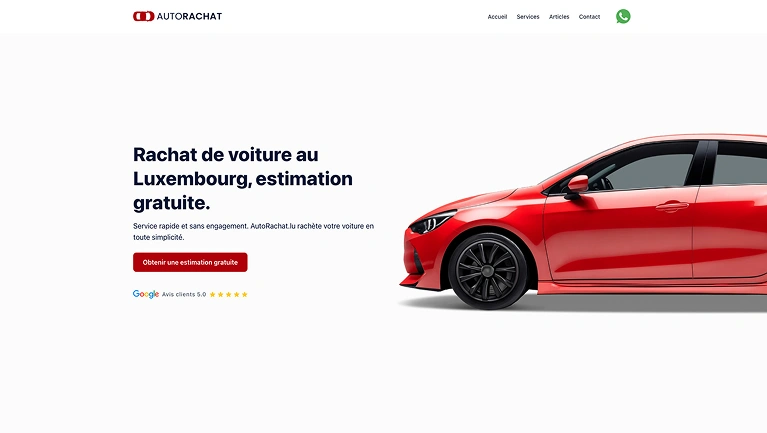
The journey changes everything. For AutoRachat, a simple, direct online journey turned +75% visitors into requests compared with the old phone process.
Which mistakes waste money on Google Ads?
The same ones show up in almost every account we take over:
- One big catch-all campaign, with every service, area and language mixed together. Impossible to know what works, impossible to adjust.
- No enquiry tracking. People judge by clicks, and optimise for clicks instead of clients.
- Ads that lead to the homepage, instead of a page that matches the search.
- No excluded searches, so the budget goes on clicks from job seekers, students and the merely curious.
- An account in the agency’s name. Your Google Ads account, with its history, should belong to you.
Google Ads or SEO: do I have to choose?
No. They do different jobs, and they strengthen each other.
Google Ads is a tap: it brings visits as soon as it’s open, and stops as soon as it’s closed. SEO, the work of appearing in the free results, builds more slowly, but keeps working for you without paying for every click.
Ads also teach you, fast, which searches bring clients: those are often the words to work on next in your website and your Google Maps profile. And a good page improves your ads, since Google takes it into account. If your site doesn’t show up in the results yet, start with our article on why your website is not showing on Google.
What should I plan for Google Ads in 2027?
Google is putting more and more automation into its tools: its systems increasingly choose the searches, the ad text and the placements by themselves, and its results show more and more AI-generated answers.
This automation can save time. But it optimises what you ask it to optimise. If you tell it a click is a success, it will find you clicks. If you tell it a qualified call is a success, it will look for qualified calls.
For 2027, three habits:
- Stay in control of what you measure. Real enquiries, and ideally signed clients, not clicks.
- Regularly read the searches that actually triggered your ads, and keep excluding the ones that aren’t for you.
- Look after your landing pages. When the machine chooses part of the targeting, the quality of your page becomes one of the levers that stay entirely in your hands.
Where do I start?
Start small and measured: one priority service, one area, one language, with call and form tracking in place from day one. Then expand what pays. That’s exactly how we work with our Google Ads service, alongside our SEO service so that advertising and free visibility feed each other. To go further, also read Yellow Pages or Google: where to spend your budget in Luxembourg.
Related articles
Keep reading.
Strategy
AI for small businesses in Luxembourg in 2027: 7 practical uses
AI for your Luxembourg SME in 2027: 7 practical uses, from phone calls to quotes, when to avoid it, how to protect your data and which task to start with.
Read articleStrategy
AI phone receptionist: stop missing client calls
An AI phone receptionist answers your calls, qualifies the request and books appointments. Who it suits, what it must not do, GDPR and how to start small.
Read articleSEO
SEO in 2027: getting found on Google and in AI answers
SEO in 2027: how to get found in Google results, on Google Maps and in AI answers. What stays the same, what matters more, and what to do now in Luxembourg.
Read article